
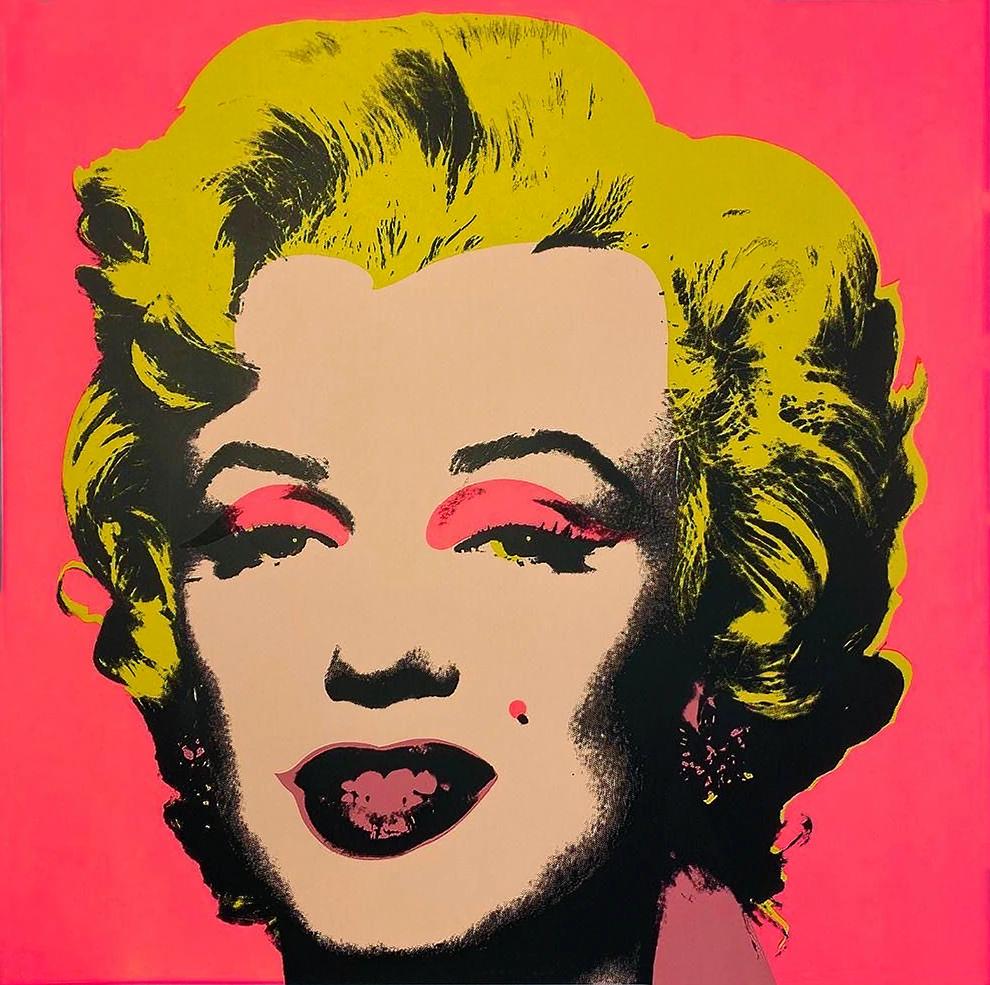
Andy Warhol’s Marilyn Monroe arrives with a sense of recognition already built in. The face is familiar, but the colours resist naturalism, turning a publicity image into something both glamorous and conspicuously manufactured. That tension is central to the work: Warhol gives viewers the celebrity they recognise while directing their attention towards the way a face becomes an endlessly repeated cultural product.
The image also sits at the centre of a market whose most dramatic headlines can make the artist seem financially remote. On 9 May 2022, Christie’s sold the painting Shot Sage Blue Marilyn for US$195 million. It was an exceptional result for a specific painting, rather than a price that can be applied to every Marilyn image, and it should be kept separate from the market for Warhol’s edition prints.
Repetition was part of the idea
Warhol drew on a publicity photograph for the 1953 film Niagara, using a face already designed to circulate through the machinery of Hollywood. The photograph gave him a recognisable starting point, while changes in colour and the act of repetition shifted attention from the individual sitter towards the public image. The work asks the viewer to consider both the person and the process that turns a person into a symbol.
In 1967, the Marilyn Monroe portfolio carried that investigation into ten screenprints with different colour combinations. The print illustrated in this article, Marilyn Monroe (F&S II.31), belongs to that edition history. Its catalogue reference is useful because it distinguishes one particular work within a body of images that can otherwise be grouped too casually under the word “Marilyn”.
Screenprinting also connects the artistic subject to the way the object is made. A photographic image is translated through layers of ink, allowing repeatability and artificial colour to become visible parts of the result. Spending time with the physical print can make those relationships more apparent than a small reproduction does, especially where colour changes the balance between the face, its features and the surrounding space.
One artist can have several different markets
The record painting and a Marilyn portfolio print share an artist and a subject, but the appropriate comparisons for their valuations are different. The production, edition, signature, condition and provenance of the print establish its own identity, while sales of genuinely comparable impressions help place it in the market. A painting headline can explain Warhol’s wider cultural stature without providing a ready-made valuation for a work on paper.
This distinction is particularly helpful for newcomers because it replaces an intimidating all-or-nothing impression with a more accurate picture. “Collecting Warhol” can describe different objects and different levels of commitment, rather than a single market in which every decision is measured against a nine-figure sale. The reader can concentrate on the work available to them and ask whether its particular combination of art, evidence and price is convincing.
A further step towards participation
Where a print is offered fractionally, several collectors can hold interests linked to that one physical work rather than each buying a separate impression. The artwork remains intact, while the provider’s terms define the units, their rights and the arrangements for holding or eventually realising the investment. Fractionalisation therefore adds another route to consider within the print market, rather than creating a new Warhol artwork.
The QU4RTER includes Warhol in its collection, giving readers a concrete place to examine that proposition. Start by identifying the exact print, then connect its valuation with the Fraction price and purchase terms. The famous face makes an inviting introduction, but the reward of looking more closely is a fuller understanding of Warhol’s ideas and a clearer view of what participating in a particular work would mean.