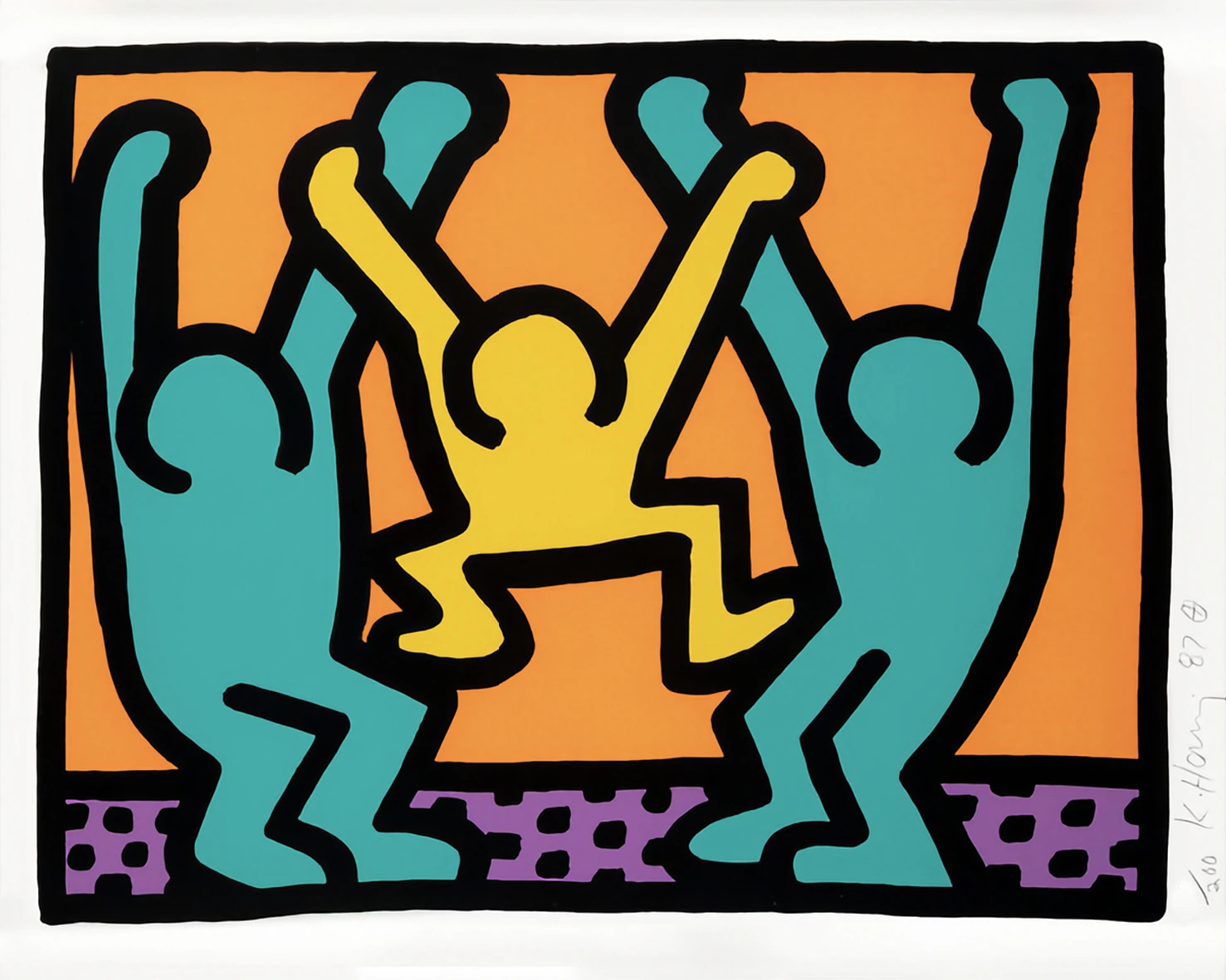
When Keith Haring drew on the black paper covering unused advertising spaces in the New York subway, he placed art in front of an audience that had not bought a ticket or chosen to enter a gallery. Commuters encountered his barking dogs, animated figures and radiating lines as part of the city’s daily life, helping a distinctive visual language become familiar beyond the relatively small circle of people who bought contemporary art.
That public ambition did not disappear as his reputation grew. In April 1986, Haring opened the Pop Shop in New York, selling items including T-shirts, posters and badges carrying his images. The shop brought his work into people’s everyday lives through objects they could afford and use, making the distance between cultural recognition and physical possession much shorter than a gallery purchase would have allowed.
Accessibility was part of the work
Haring’s simplified figures are easy to recognise, but their apparent simplicity can hide the seriousness of their subjects. Movement, connection and collective energy sit alongside concerns about power, prejudice and illness. His involvement in AIDS awareness and other social causes gave public visibility a purpose: an image could communicate an urgent idea to people who might never read an artist’s statement or follow an exhibition programme.
The Pop Shop extended that way of thinking into commerce. A shirt could carry a Haring image through the street, while an inexpensive object gave its owner a direct relationship with an artist whose paintings might already have been beyond their reach. The project also exposed a tension that remains central to Pop Art: an image can circulate widely and become part of popular culture while particular physical works become scarce and expensive.
For today’s collector, that distinction is essential. A licensed object, a limited-edition print and a unique drawing may all carry Haring’s visual language, but they are different kinds of objects with different production histories. Their connection to the artist does not make them interchangeable in the market, and understanding what is actually being offered is more useful than treating every appearance of a familiar figure as the same sort of collectible.
When a public image becomes a private asset
A strong secondary market can increase the distance between an artist’s audience and the people able to buy significant works. That does not erase the artist’s achievement in reaching the public, but it can create an awkward result: millions of people may know and value an image, while access to the investment connected to a particular authenticated work remains concentrated among buyers with substantial budgets.
Fractionalisation offers one response to that problem. By dividing an investment linked to a named artwork into smaller units, it allows several people to participate without each acquiring the whole physical object. Where a Haring work is offered in this way, the buyer’s interest concerns that specified work under the platform’s terms; it is different from purchasing merchandise, and different again from owning a print outright and taking it home.
This is a contemporary collecting mechanism, rather than evidence that Haring would have endorsed a particular platform or financial model. Its relevance lies in the question his career makes unavoidable: how can a large audience develop a meaningful relationship with art when ownership of the most sought-after objects becomes increasingly difficult to afford?
A closer look is the useful first step
The QU4RTER includes Haring among the artists represented in its collection, giving curious readers a practical way to examine how fractional participation is presented. Begin with the work itself, looking at its edition and documentation, then establish the rights and costs attached to the Fraction. The familiar figures can make the introduction welcoming without doing the financial research on the buyer’s behalf.
Haring’s legacy is a reminder that accessibility has several meanings. Seeing an image, living with it on an everyday object, standing before an authenticated work and holding an investment interest are different experiences, each with its own value. Fractional art adds another possibility to that history, and becomes most interesting when it brings people into a richer understanding of the artist as well as a smaller financial commitment.