
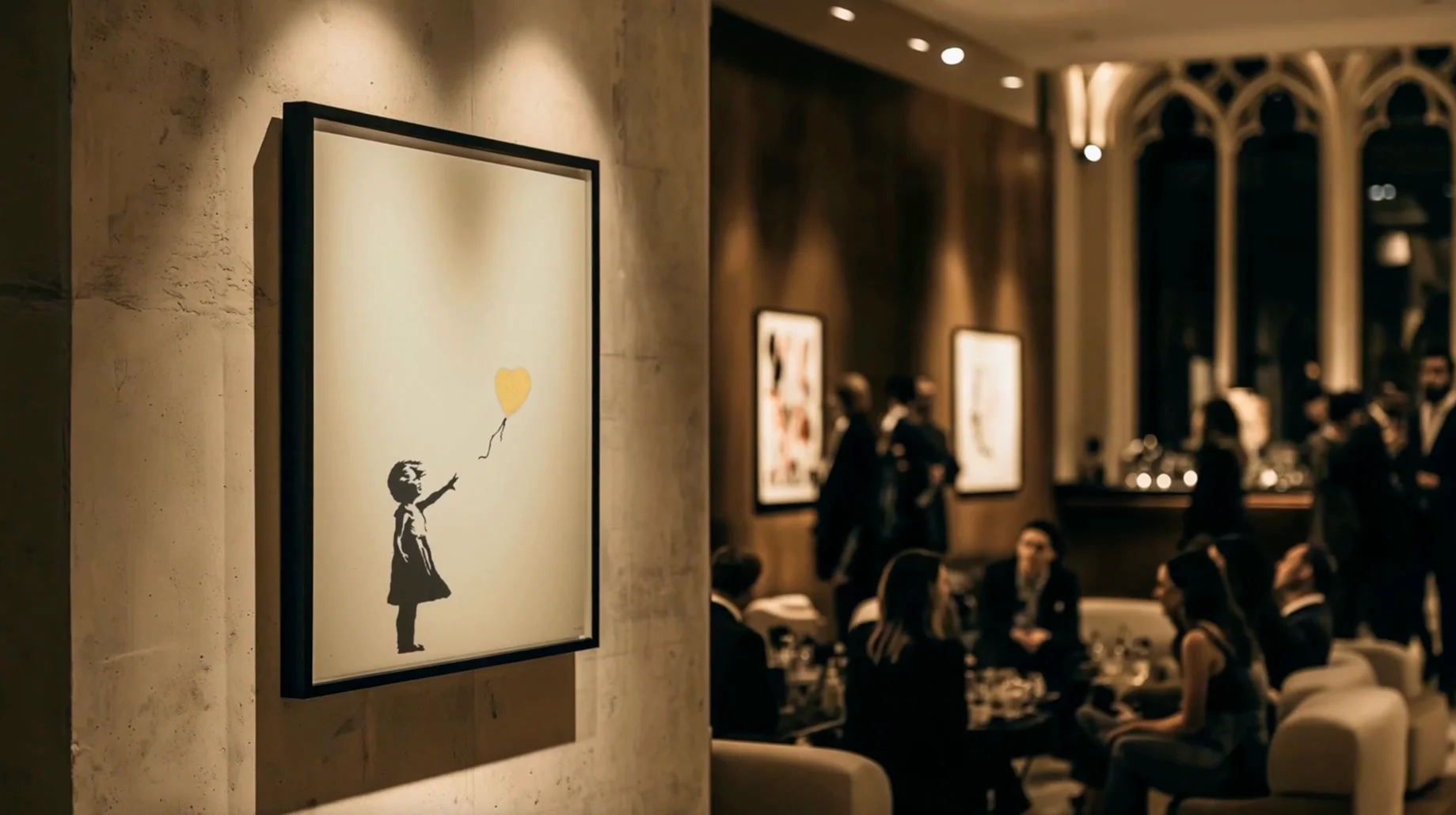
The girl reaching for her balloon, the protester throwing flowers, the policeman wearing a yellow smile: Banksy has created images that people recognise long before they know the titles. His work travels through photographs, news reports and conversations about politics, protest and the price of art, reaching an audience far larger than the number of people able to buy an original work or a sought-after print.
London start-up The QU4RTER is addressing that gap by offering Fractions linked to individual works in its Banksy collection, with entry points from £500. The collection brings together signed editions, artist’s proofs and original works, opening a route into a market whose familiar images have often been accompanied by unfamiliar, and substantial, prices. For a fan accustomed to watching from the sidelines, the attraction is being able to investigate a particular artwork without first finding the money to purchase it outright.
Why the same image can describe very different works
Banksy’s ability to communicate quickly helps explain his reach. In Love Is in the Air, a figure apparently preparing to throw a weapon holds a bunch of flowers instead; in Flying Copper, an imposing police officer has angel’s wings and a smiley face. The visual joke makes each image accessible, while the tension between authority, violence and innocence gives the viewer something to return to after the first encounter.
The collector’s task begins when that recognisable image becomes a particular physical object. A signed print, an unsigned edition, an artist’s proof and an original painting can share a subject while having different production histories and different markets. An artist’s proof is an impression outside the main numbered edition; the designation needs to be understood alongside the work’s condition, documentation and rarity. It does not automatically make every proof more valuable than every standard impression.
This is why a fractional collection is most interesting when it lets people look more closely. The image may introduce the artist, but the edition details, authentication and valuation explain what the investor is actually considering. A headline auction result for one version should provide context, rather than become a price label attached to every work bearing the same title.
What fractionalisation changes
Fractionalisation divides participation in an artwork into smaller units, allowing several people to hold an interest linked to the same underlying work. The physical artwork remains intact and is held under the arrangement set out by the provider. Instead of committing the entire acquisition price to one Banksy, a collector can consider a smaller position and, if appropriate, build interests across more than one work or artist over time.
That changes the scale of the decision rather than removing the need to understand it. A Fraction’s rights, charges and potential route to resale come from its purchase terms; buying one does not necessarily confer the same legal rights as taking sole ownership of a framed print. Nor does dividing a work make its value certain. The useful advance is a more manageable starting point from which to learn about the object and decide whether its investment proposition makes sense.
From a familiar image to a considered choice
The QU4RTER also connects its collecting model with an Art Lounge concept, intended to bring members together around physical works. Its first space is being created in a former chapel in Shoreditch, with opening and access details still to be announced. That ambition gives the proposal a cultural dimension alongside its financial one: an opportunity to spend time with art that might previously have existed only as an image on a screen.
For readers who already follow Banksy, the collection offers a practical place to begin exploring fractional art. Choose an image that holds your attention, establish which version is offered, then follow the information through to the valuation and Fraction terms. The significant shift is that recognising the work can now lead to a decision about participating in it, at a level considerably smaller than buying the whole object.