
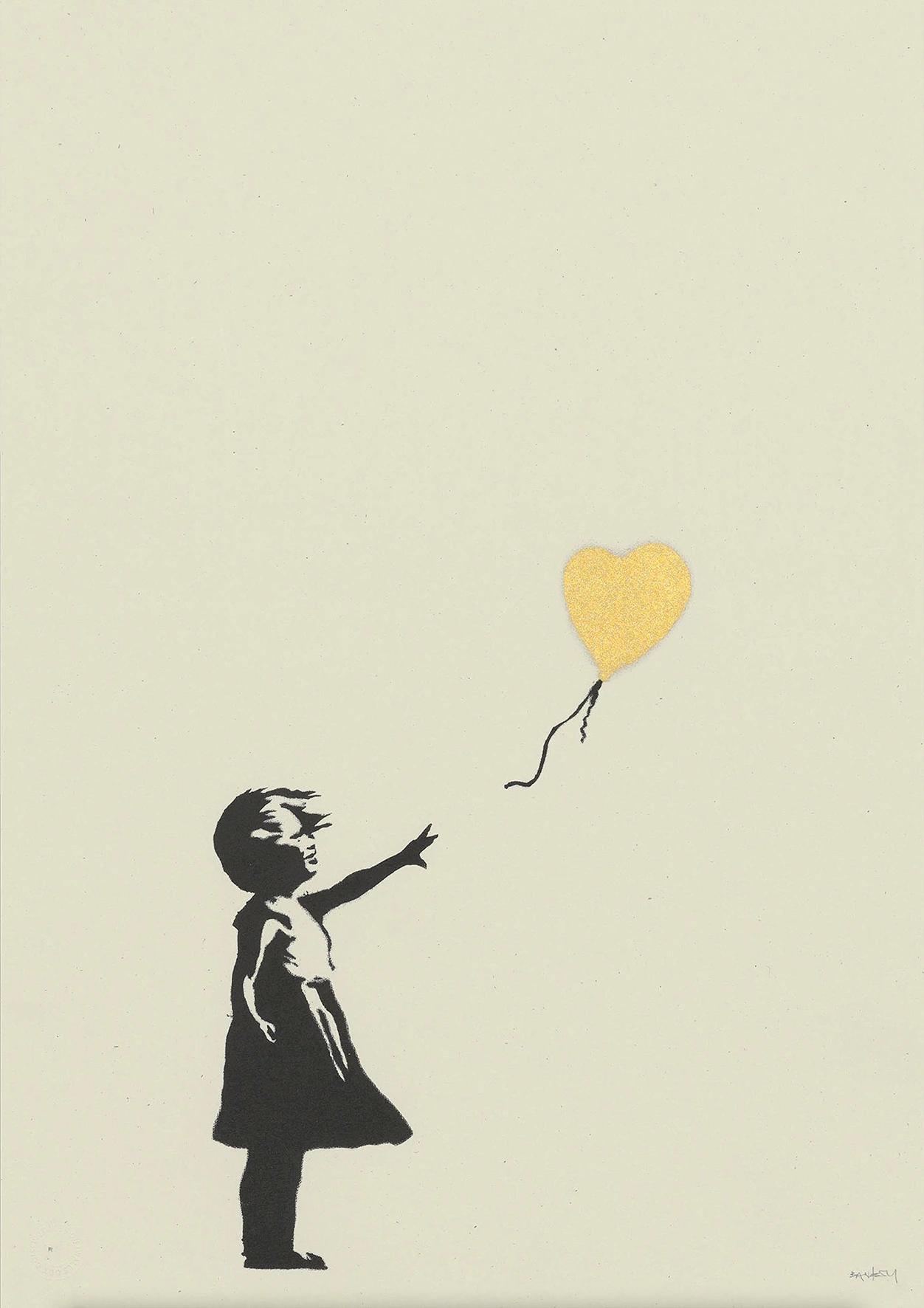
A child reaches towards a heart-shaped balloon, and the space between them carries much of the image’s emotion. Banksy’s Girl with Balloon is simple enough to register immediately, yet open enough to invite different readings of hope, separation and loss. That combination has allowed it to travel far beyond its first street setting, becoming an image people recognise without necessarily knowing how its physical versions differ.
One of those versions made an especially striking auction story on 25 March 2021, when a gold-colour artist’s proof sold at Sotheby’s London for a reported £1,104,000 including premium. The result concerned a particular screenprint, rather than the image in every form. Understanding why that distinction matters makes the sale more useful to a new collector than treating it simply as another extraordinary number attached to Banksy’s name.
The catalogue describes the object behind the headline
Sotheby’s identified the work as a 2004 screenprint, signed and numbered AP 7, with the publisher’s Pictures on Walls blindstamp. Its description placed the work within a group of 88 artist’s proofs comprising different colour variants, and recorded an accompanying Pest Control certificate. Those details locate the gold impression within a specific production and authentication history.
The phrase “artist’s proof” therefore needs to be read with the rest of the entry. It does not mean that the balloon image was unique, or that every proof shares exactly the same scarcity. The colour, numbering and documented group matter together, just as the provenance and condition of an individual impression can affect the way collectors assess it. A title gets the reader to the right subject; the catalogue gets them to the right object.
There is also an important distinction between the famous image and another event in its market history. The work partially shredded at Sotheby’s in 2018 became Love Is in the Bin, a separate artwork with its own identity. Its dramatic story helped reinforce the cultural visibility of Girl with Balloon, but it should not be confused with the gold screenprint or used as if the two were interchangeable examples of the same investment.
Recognition can create interest without fixing a price
The appeal of a rare variant is easier to understand when the underlying image already matters to people. A collector may recognise the composition instantly, then become interested in the way a change of colour alters its character or in the limited availability of that particular version. Cultural familiarity and object-specific scarcity can meet in the same work, helping explain why the catalogue details deserve as much attention as the image.
An auction result still records one transaction at one moment. The amount includes the circumstances of that sale and should not be treated as a current valuation for another impression without further evidence. Different editions, colourways and physical conditions can lead to different comparisons, and a memorable historical price does not establish what any version will achieve in the future.
How the story connects to fractional art
Fractionalisation can let several people participate in an interest linked to a significant artwork without each paying for the entire object. In the case of a well-known image, that creates an opportunity to move from admiration to a more detailed investigation, provided the offered work is identified as carefully as the auction example. The smaller unit needs to connect to a precise edition and a reasoned current valuation.
For readers exploring Girl with Balloon or another Banksy through The QU4RTER, the historical sale supplies a useful starting point for questions, rather than a promise about performance. Establish which work is actually offered, compare the relevant evidence and understand the rights attached to the Fraction. The story becomes more interesting as those details accumulate: a small gold balloon can reveal a great deal about how images acquire cultural significance and how particular objects acquire a market.